Table of Contents
Marketing Plan
Introduction
This chapter presents the marketing strategy for TRAQUA, based on insights derived from the market analysis. It outlines the key decisions required to successfully introduce the product to the market. The chapter includes the Business Model Canvas, SWOT analysis, strategic objectives, segmentation and targeting, positioning, and the marketing mix (4Ps). It also addresses branding, budgeting, and control mechanisms to ensure effective implementation and performance evaluation.
Business Idea Formulation
Before approaching potential customers or developing prototypes, it is important to clearly define and refine the value proposition of the proposed solution. The goal is to ensure that the concept addresses a real user problem while delivering a meaningful benefit. For the TRAQUA project, the business idea focuses on improving both the safety and the consistency of daily hydration. Many health-conscious individuals regularly use reusable water bottles however, they are often unaware that these containers can accumulate bacteria if they are not cleaned frequently [1]. At the same time, many people struggle to maintain a consistent hydration routine throughout the day. TRAQUA addresses these challenges by combining bottle sanitization technology with hydration monitoring in a single integrated system.
The proposed solution is a smart bottle equipped with an Integrated Smart Base that includes UV-C LEDs and TDS sensors. The UV-C technology automatically sterilizes the interior of the bottle, eliminating biological contaminants that may develop over time. Meanwhile, the sensors monitor water purity, ensuring that the stored water remains safe for consumption. By automating the sanitization process, the system removes the need for users to manually clean the bottle as frequently and provides additional confidence in the safety of the drinking environment.
In addition to improving hygiene, the TRAQUA Smart Bottle supports users in maintaining healthier hydration habits. The bottle connects to a mobile application that provides hydration tracking, reminders, and personalized feedback. Through gamified features and visual progress indicators, the application encourages users to meet their daily hydration goals and build more consistent habits. Although several smart bottles and simple hydration trackers are already available on the market, most of them focus primarily on measuring water intake. In contrast, TRAQUA differentiates itself by addressing both bottle hygiene and hydration behavior. By ensuring that the container remains sterile while also supporting user engagement through digital features, the solution offers a more comprehensive approach to safe and consistent hydration.
Business Model
To visualize and analyze how TRAQUA creates, delivers, and captures value, the team developed a comprehensive Business Model Canvas. This strategic tool illustrates the alignment between our technical innovation and the market’s demand for reliable hydration and hygiene solutions. Figure 1 shows the business model.

After presenting the Business Model Canvas, a detailed analysis is provided to explain how each component contributes to the overall functioning of the TRAQUA business model. This description is essential to demonstrate the logical connections between key elements such as value creation, customer segments, and revenue streams. By analyzing these components, the team highlights how TRAQUA effectively delivers value to its target users while ensuring economic viability. Furthermore, this breakdown allows for a clearer understanding of the strategic decisions behind the product, supporting the alignment between technological innovation, market needs, and sustainability considerations.
Key Partnerships
The project relies on a network of Key Partnerships to ensure both technical quality and market readiness. We collaborate with specialized hardware suppliers who provide the sensors and microchips required for our production line. Beyond the supply chain, Academic Mentors act as primary supervisors, offering the technical and strategic guidance needed to transition from a prototype to a viable product.
Universities also play a critical role in our development strategy as the main setting for the pilot stage. By providing the TRAQUA Smart Bottle to students, we can collect real-world data and user feedback. This phase allows us to evaluate system performance in a high-activity environment and refine the Hydration Coaching algorithms before a full-scale commercial launch.
Key Activities and Resources
The operational success of TRAQUA is driven by several Key Activities, including intensive research and development to optimize UV-C pathing and app development to ensure a seamless user experience. Part assembly and quality control are essential to our production process, ensuring each unit meets safety standards.
To support these activities, we rely on Key Resources such as specialized hardware (sensors, UV-C, and microcontrollers), prototyping tools and equipment, and knowledge related to our water-purity algorithms.
Value Creation and Delivery
The Value Propositions block highlights our differentiation through active sterilization and real-time water purity validation. Unlike passive containers, TRAQUA adds value by eliminating the need for manual cleaning and providing objective data on water quality. In addition, the Hydration Coaching feature encourages consistent hydration by reminding users to drink throughout the day.
This value is delivered to our primary customer segment active students, young adults, and health enthusiasts through an omnichannel strategy. This includes direct-to-consumer sales via our official website and partnerships with major e-commerce platforms such as Amazon. The product will also be available in premium retail stores targeting athletes and consumers who prioritize high-quality health technology and are willing to pay for verified performance.
Value Capture
TRAQUA captures value through a diversified revenue model. While primary sales of the physical bottle generate immediate income, a premium app version introduces a recurring revenue stream. This model is balanced against a cost structure focused on high-quality manufacturing, including production and assembly, as well as software and operational expenses related to maintaining our digital ecosystem.
Together, these elements ensure that the business remains sustainable as it scales from a university pilot to the broader consumer market.
Market Analysis
To gain a thorough understanding of market dynamics, customer needs, and the external factors influencing the success of the project, conducting a market analysis is essential. This process enables the team to view the market as a continuously evolving environment, ensuring that the TRAQUA bottle remains relevant and competitive.
Our analysis is divided into two main categories: macro-analysis and micro-analysis. Considering both perspectives improves the effectiveness of the organization’s marketing strategy and supports the long-term development of the brand. Continuous evaluation of these factors is also crucial to ensure that the organization is not negatively impacted by emerging internal or external forces [2].
Macro Analysis
Macro-analysis examines broader social forces — commonly referred to as PESTEL factors — that influence the entire business environment.
- Political/Legal – Government regulations and legal frameworks influence business operations. TRAQUA must comply with safety standards related to UV-C technology and data protection laws for its app ecosystem.
- Economic – Economic conditions, including income levels and consumer spending patterns, affect purchasing power. TRAQUA targets consumers willing to pay a premium for high-quality, durable health technology. However any changes in economic conditions and consumer spending patterns may reduce demand for premium-priced products.
- Social/Cultural – Social trends and cultural values shape consumer behavior. The growing focus on health, wellness, and sustainability creates a strong opportunity for a reusable, technology-enabled hydration solution [3].
- Technological – Advances in sensor technology enable TRAQUA to innovate by offering features such as Hydration Coaching and real-time water quality monitoring.
- Environmental – Environmental concerns relate to resource use and ecological impact. TRAQUA addresses the need to reduce single-use plastic waste by promoting a sustainable and reusable product [4].
Micro Analysis
Micro-analysis focuses on the forces close to the company that directly affect its ability to serve customers.
- Suppliers – Partners who provide the resources necessary to produce our product. These include hardware suppliers specializing in the production of sensors and microchips used to measure and support the bottle’s key features. Examples of such suppliers include companies like Mouser Electronics, Farnell, and Digi-Key, which offer a wide range of components required for prototyping and production.
- Customers – Individuals who purchase the product for personal use. Our primary segments include active students, young adults, and health enthusiasts who prioritize proper hydration and a healthy lifestyle.
- Competitors – A comparison of existing products is presented in Table ##REF:tab:products## . Currently, no single product combines all of TRAQUA’s features, which creates an opportunity for competitive advantage.
- Resellers – Intermediaries who help promote, sell, and distribute TRAQUA products to final consumers. These may include online platforms and retail partners such as Amazon, specialized tech retailers, and premium lifestyle stores that focus on innovative and health-related products.
- Publics – Groups that have an interest in or impact on the organization: (i) Academic mentors, who provide technical and strategic guidance, supporting the transition from prototype to a market-ready product, (ii) Universities, which act as a key local public and serve as the primary environment for the pilot stage, and (iii) Influencers, particularly in the health, fitness, and lifestyle sectors, who can shape public perception and support brand awareness through digital communication.
SWOT Analysis
The SWOT analysis Figure 2 allows the team to evaluate the internal Strengths and Weaknesses of the TRAQUA project alongside the external Opportunities and Threats present in the dynamic health-tech environment.

Internal Factors
Strengths:
- Technological Innovation: The integration of UV-C sterilization with high-precision sensors provides a solution not currently available in the standard bottle market, giving Traqua a strong competitive advantage.
- Integrated Ecosystem: Features such as Hydration Coaching and gamification enhance the user experience and help build long-term customer loyalty.
- Strong Value Proposition: The combination of real-time water purity validation and active sterilization delivers clear functional value, differentiating Traqua from traditional reusable bottles.
Weaknesses:
- Price Sensitivity: The high cost of specialized sensors and microchips increases the final product price, which may discourage price-sensitive consumers compared to simpler, low-cost alternatives. Additionally, production costs may fluctuate due to external factors such as fuel prices, supply chain disruptions, and global economic conditions, which can further impact the final pricing strategy and profitability.
- Operational Complexity: Dependence on advanced hardware and ongoing software maintenance increases production complexity and places higher demands on quality control and technical support.
- Limited Brand Awareness: As a new product, TRAQUA may initially struggle to build trust and recognition in a competitive market dominated by established brands.
External Factors
Opportunities:
- Growing Health and Sustainability Trends: Increasing awareness of health, hydration, and environmental issues is driving demand for reusable and technology-enhanced products, particularly among younger consumers.
- Access to University Research and Collaboration: Using universities as testing environments enables efficient data collection, product refinement, and early adoption within a key target segment. This approach is also cost-effective, as it allows the team to conduct real-world testing and marketing activities at relatively low cost and risk. By leveraging existing academic networks and infrastructure, TRAQUA can validate its product and business model before committing to large-scale market entry
- Expansion of Smart Technology Market: The rising popularity of smart devices creates opportunities for TRAQUA to position itself within the broader health-tech ecosystem.
Threats:
- Rapid Technological Change: Fast-paced advancements in technology require continuous updates to both hardware and software. Failure to keep up may result in product obsolescence.
- Economic Uncertainty: Changes in economic conditions and consumer spending patterns may reduce demand for premium-priced products.
- Increasing Competition: Established brands or new entrants may introduce similar features at lower prices, reducing TRAQUA's competitive advantage over time.
Strategy
An effective marketing strategy is essential for connecting a company’s product with its target audience and ensuring long-term success. It involves understanding customer needs, analyzing market conditions, and developing coordinated actions that allow a business to achieve its objectives. Marketing strategies are not static, they must continuously adapt to changing market trends, consumer behaviour, and technological developments [5].
Strategic Objectives
The primary strategic objective of TRAQUA is to successfully introduce a smart hydration solution to the market and establish a clear competitive position within the health-tech industry. To achieve this, the project defines key goals across three critical pillars: economic, customer-oriented, and product-oriented.
Economic objectives focus on ensuring financial sustainability and long-term profitability:
- Revenue Generation - achieve steady revenue growth through the sale of the TRAQUA smart bottle and the introduction of a premium app subscription model.
- Cost Management - maintain cost efficiency in production and operations while ensuring high product quality.
- Profitability - reach break-even point within the early stages of market entry (after the pilot phase) and gradually increase profit margins.
Customer-oriented objectives focus on attracting, satisfying, and retaining users:
- Customer Acquisition - gain early adopters within the student and young adult segments through pilot programs and targeted marketing campaigns.
- Customer Satisfaction - deliver a high-quality product and user experience that meets expectations in terms of functionality, reliability, and ease of use.
- Customer Retention - build long-term relationships through app engagement, personalized hydration coaching, and continuous product improvements.
- Brand Awareness - increase brand recognition among target segments through consistent promotion and digital presence.
Product-oriented objectives relate to innovation, quality, and continuous improvement:
- Product Development - continuously enhance the smart bottle and mobile application based on user feedback and technological advancements.
- Innovation Leadership - maintain a competitive edge by improving features such as UV-C sterilization, sensor accuracy, and data analytics.
- Quality Assurance -ensure high standards of safety, durability, and performance through rigorous testing and quality control processes.
- User Experience Optimization - improve usability, design, and functionality to create a seamless and intuitive product experience.
Segmentation and Targeting
To effectively reach its audience, TRAQUA applies a segmentation strategy based on demographic, behavioural, and psychographic factors. This approach allows the company to better understand customer needs and tailor its offering accordingly [6].
- Demographic Segmentation: TRAQUA primarily targets young adults, particularly students and early-career individuals, who are more open to adopting new technologies and lifestyle-oriented products.
- Behavioural Segmentation: The product is aimed at consumers who actively monitor their health, use fitness or smart applications, and are interested in improving their daily habits, including hydration.
- Psychographic Segmentation: TRAQUA focuses on individuals who are health-conscious, environmentally aware, and value innovation, convenience, and modern design [7].
Based on this segmentation, TRAQUA adopts a focused targeting strategy, concentrating on:
- Active students
- Young adults
- Health enthusiasts
- Eco-Conscious Professionals
These consumers are more likely to invest in products that enhance their well-being and support a sustainable lifestyle.
Marketing Persona
To better represent the target audience, a marketing persona has been developed:
- Name: Max
- Age: 23
- Occupation: University student
- Lifestyle: Active and busy, regularly attending classes, working part-time, and engaging in fitness or outdoor activities
- Behaviours: Uses mobile applications to track health and productivity, values convenience, and is open to adopting new technologies
- Needs: A reliable and easy way to maintain proper hydration, ensure water safety, and reduce the effort associated with bottle cleaning
- Values: Health, sustainability, efficiency, and modern design
This persona in Figure 3 illustrates the typical TRAQUA user and helps guide product development, communication strategies, and marketing decisions.

Positioning
Positioning defines how TRAQUA is perceived in the minds of consumers relative to competing products. The objective is to establish a clear, distinctive, and desirable place in the market by emphasizing the product’s unique combination of features and benefits [8].
TRAQUA is positioned as a premium, high-technology smart bottle. Unlike traditional reusable bottles and basic smart bottles, TRAQUA offers a comprehensive solution by combining UV-C sterilisation, real-time water purity monitoring, and personalised hydration coaching within a single ecosystem. This positioning allows TRAQUA to differentiate itself from competitors by delivering a broader and more advanced set of features. While many existing products focus on only one function—such as hydration tracking or sterilization—Traqua integrates multiple capabilities, creating a more complete and intelligent user experience.
The perceptual map in Figure 4 is based on the products analyzed in Table ##REF:tab:products##, ensuring consistency between the comparative analysis and the visual positioning of competitors. The map visually represents TRAQUA’s position in relation to key competitors based on two dimensions: price and level of technology. On the horizontal axis, products are arranged from low to high technological complexity, while the vertical axis represents price from low to high. Traditional reusable bottles, such as Equa Smart and Ozmo Active, are positioned in the lower-left quadrant, reflecting their relatively low price and limited technological features. Mid-range smart bottles, such as HidrateSpark, offer more functionality but remain moderate in both price and technology. Premium competitors like LARQ and Aqua Vault are located in the upper-right area of the map, indicating higher prices and more advanced features, particularly in sterilization technology. However, TRAQUA is positioned further along the technology axis and slightly below the highest-priced competitor, highlighting its more advanced and integrated functionality while maintaining a relatively more accessible price point.
This positioning reinforces TRAQUA’s strategy of differentiation through innovation rather than price competition. By offering a unique combination of features within a single product, TRAQUA targets consumers who prioritise quality, performance, and long-term value. The perceptual map clearly illustrates that TRAQUA occupies a distinct position in the market, delivering the highest level of technological integration while remaining competitively priced within the premium segment.

Marketing-Mix
The marketing mix is a fundamental framework used to implement marketing strategy by combining key controllable elements that influence consumer response. It consists of four main components - Product, Price, Place, and Promotion - which must be carefully coordinated to meet customer needs and achieve organizational objectives [9]. For TRAQUA, the marketing mix is designed to support its positioning as a premium, technology-driven hydration solution and to create a strong competitive advantage in the market.
Product
The core product is the TRAQUA smart bottle, which integrates advanced features such as UV-C sterilization, real-time water purity monitoring, and a connected mobile application offering hydration tracking and coaching. The product strategy focuses on:
- Advanced technological functionality
- User-friendly interface and seamless app integration
- Sustainability through reusability and reduced plastic waste
In addition to the physical product, the digital ecosystem (mobile app and premium features) enhances the overall value proposition, transforming TRAQUA from a simple bottle into a comprehensive health-support tool.
Price
TRAQUA adopts a premium pricing strategy, reflecting its advanced technology, innovation, and added value compared to traditional bottles. Taking into consideration mass production, the estimated cost of one bottle will be around 160 - 220 €. The pricing strategy is based on:
- Value-based pricing – aligning price with perceived benefits (health, safety, convenience)
- Competitive positioning – remaining within the premium segment while still being more accessible than the most advanced competitors
- Revenue diversification – combining product sales with steady revenue from a premium app subscription
This approach reinforces the brand’s high-quality image while ensuring long-term financial sustainability.
Place
The distribution strategy focuses on making the product easily accessible while maintaining its premium positioning. TRAQUA will be distributed through:
- Direct-to-consumer channels (official website)
- E-commerce platforms (e.g., Amazon)
- Selective retail outlets, particularly premium and sports-oriented stores
Additionally, the university pilot program plays a key role in early distribution, allowing the product to reach its primary target audience and generate initial market traction. This multi-channel approach ensures both availability and brand control.
Promotion
The promotion strategy is designed to increase brand awareness, inform potential customers, and clearly communicate the product’s unique value.
Key promotional activities include:
- Collaborations with influencers in the fitness, health, and lifestyle sectors
- Social media marketing targeting students and young adults
- University-based campaigns during the pilot phase
- Digital advertising and content marketing highlighting health, innovation, and sustainability
The communication strategy emphasizes:
- The benefits of clean and safe water
- The convenience of smart hydration tracking
- The environmental impact of reusable solutions
This integrated promotional approach ensures consistent messaging and strong engagement with the target audience.
Brand
The TRAQUA brand is designed to clearly communicate the product’s core value: combining advanced technology with everyday hydration. Both the name and visual identity play a key role in reinforcing this positioning and creating a strong connection with the target audience.
Brand Name and Logo
The name TRAQUA is a strategic combination of the words “Track” and “Aqua,” reflecting the brand’s dual focus on technology and water.
- Track represents the monitoring aspect of the product, including hydration habits, user goals, and real-time water quality analysis. It highlights the dynamic and continuous interaction between the user and the product through data and feedback.
- Aqua emphasizes the core function of the product - water. It reinforces the brand’s focus on purity, safety, and hydration, as well as the key feature of active sterilization.
Together, the name communicates a clear and memorable message: a smart solution that combines hydration with intelligent tracking. The logo can be seen in Figure 5.

Flyer
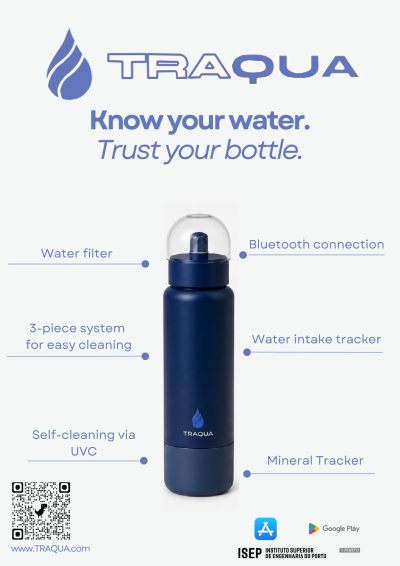
The TRAQUA flyer Figure 6 is a strategic visual element designed to communicate the brand’s identity and highlight the product’s technological capabilities through a clear and intuitive layout. It helps translate complex technical features into a user-friendly message, making the product more accessible to potential customers.
The slogan, “Know your water. Trust your bottle.”, serves as the central message of the flyer. It reflects the brand’s mission by combining two key aspects: data-driven insight through water quality monitoring and a sense of safety ensured by sterilization. This reinforces TRAQUA's focus on reliability and user trust.
The flyer also uses a callout system to present the main product features. Elements such as the integrated UV-C base for self-cleaning and the mineral tracking system for real-time validation are clearly highlighted, helping users understand how the technology is embedded in the product.
In addition, the inclusion of App Store and Google Play icons, along with Bluetooth connectivity, emphasizes the digital ecosystem surrounding the product. This communicates that TRAQUA is not only a physical product but also a connected solution supported by a mobile application. Finally, the presence of institutional logos such as ISEP and P.PORTO strengthens the credibility of the project, indicating its academic background and connection to research and technical expertise.
Marketing Programmmes
Programmes
1. University Pilot Programme
The university pilot programme serves as the initial market entry strategy. TRAQUA bottles will be introduced within selected universities, allowing students to test the product in a real-life environment. This programme aims to:
- Generate early adoption among the target audience
- Collect user feedback for product improvement
- Build brand awareness through direct experience
This approach reduces risk while validating both the product and the business model.
2. Social Media Campaigns
Social media platforms will be a primary communication channel, especially for reaching younger audiences. Campaigns will focus on visually engaging and informative content. Key actions include:
- Posting content related to hydration, health, and daily habits
- Demonstrating product features and benefits
- Sharing user experiences and opinions
- Running targeted advertisements to increase reach
The goal is to create engagement, build a community, and strengthen brand visibility.
3. Product Launch Campaign
A coordinated product launch campaign will be implemented to introduce TRAQUA to the wider market after the pilot phase. Key elements include:
- Launch events or online announcements
- Limited-time offers
- Promotional bundles (e.g. bottle + premium app trial)
This programme aims to create initial demand and accelerate market penetration.
4. Influencer Marketing Programme
TRAQUA will collaborate with influencers in the fitness, health, and lifestyle sectors to promote the product. This programme includes:
- Product reviews and demonstrations
- Integration into daily routines (e.g. gym, study, travel)
- Authentic content that highlights real-life usage
Influencers help build credibility and trust, especially among younger consumers.
Budget
As part of its growth strategy, TRAQUA plans to expand its promotional activities across multiple European markets. The marketing approach will be localized, meaning that campaigns will be adapted to each country’s culture, language, and consumer preferences. A key element of this strategy is the selection of country-specific influencers and public figures, particularly those connected to fitness, health, and lifestyle. By collaborating with well-known local personalities, TRAQUA can increase credibility, relevance, and audience engagement in each market.
In the German market, personalities such as Pamela Reif — a leading fitness influencer [10] and Joshua Kimmich, a professional football player [11] are strategically selected due to their strong association with health, performance, and discipline, which closely aligns with TRAQUA’s value proposition. Collaborations with such high-profile figures require significant investment. Industry benchmarks indicate that macro-influencers with millions of followers may charge between 50 000 € and 200 000 € per campaign, while professional athletes often command even higher endorsement fees depending on the scope and duration of the partnership [12]. Therefore, the proposed budget reflects a premium market entry strategy, where a substantial portion of resources is allocated to influencer and athlete partnerships to maximize brand awareness, trust, and market impact. To illustrate this approach, a sample budget is presented for the German market, one of the largest and most health-conscious markets in Europe, is presented in Table 1.
| Item | Cost (€) | Explanation |
| Social Media Advertising | 10 000 | Budget allocated for large-scale targeted campaigns on Instagram, TikTok, and Google. Supports high reach and complements influencer exposure. |
| Influencer Collaboration (Pamela Reif) | 80 000 | Estimated cost for collaboration with a top-tier fitness influencer. High reach and strong engagement among health-conscious consumers justify the investment. |
| Athlete Partnership (Joshua Kimmich) | 120 000 | Estimated endorsement cost for a professional athlete. Builds credibility, trust, and premium brand perception. |
| Launch Campaign | 10 000 | Includes coordinated product launch, promotional offers, and digital campaigns to maximize initial market impact. |
| Content Creation | 5 000 | High-quality video production and promotional materials aligned with premium brand positioning. |
| Total | 225 000 | Total estimated budget for premium entry into the German market. |
Control
To ensure that TRAQUA’s marketing strategy is effectively implemented and continuously improved, we decided to apply the PDCA (Plan-Do-Check-Act) cycle. This approach provides a structured method for monitoring performance, evaluating results, and making necessary adjustments.
Plan
In the planning phase, TRAQUA defines its marketing objectives, strategies, and key performance indicators (KPIs). These include targets related to sales, customer acquisition, brand awareness, and user engagement.
Key targets include:
- Achieving 1000 – 2000 units sold within the first year
- Reaching 500 – 1000 users during the university pilot phase
- Growing to 3000 + users after market launch
- Building 5000 – 10000 social media followers
- Maintaining 60 – 70 % customer retention rate
- Ensuring 40 – 50 % weekly active app users
Clear benchmarks are established to measure success, such as expected growth in users, revenue generation, and app activity levels.
Do
In this phase, the planned marketing activities are implemented. This includes executing marketing programmes such as:
- University pilot campaigns
- Social media and digital marketing
- Influencer partnerships
- Product launch initiatives
The goal is to deliver the strategy as designed and reach the defined target audience effectively.
Check
This phase focuses on monitoring and evaluating performance by comparing actual results with planned objectives. Key performance indicators include:
- Sales volume and revenue (target: 1000 – 2000 units/year)
- Customer acquisition rate (target: steady monthly growth)
- Customer retention rate (target: 60– 70 %)
- Social media engagement (likes, shares, follower growth)
- Website traffic and conversion rates
- App usage metrics (target: 40 – 50 % weekly active users)
Data is collected and analyzed regularly to assess the effectiveness of marketing activities and identify any gaps or issues.
Act
Based on the evaluation, corrective actions are taken to improve performance. This actions may involve:
- Adjusting marketing campaigns or communication strategies
- Refining pricing or promotional offers
- Improving product features based on customer feedback
- Modifying targeting or distribution channels
This phase ensures that the strategy remains flexible and responsive to market changes.
By applying the PDCA cycle, TRAQUA ensures a process of continuous improvement. This allows the company to adapt to evolving customer needs, technological developments, and competitive pressures, ultimately supporting long-term success.
Summary
The market analysis provided a comprehensive understanding of both the micro- and macro-environment in which company will operate. It highlighted key trends such as increasing health awareness, the growing demand for sustainable products, and rapid technological advancements in the smart consumer goods sector.
Based on this market and economic analysis, the team decided to develop a smart hydration bottle with integrated UV-C sterilization and real-time water quality monitoring, targeted at health-conscious consumers, active students and young adults. This decision is supported by the rising demand for innovative, sustainable, and health-focused solutions, as well as a clear gap in the market for a product that combines hygiene, hydration tracking, and smart features. Consequently, the proposed solution incorporates key features driven by market needs, including active sterilization, real-time purity validation, hydration coaching, and mobile application integration. These elements respond directly to consumer expectations for convenience, safety, and sustainability, while also providing a strong competitive advantage.
The findings of this chapter not only justify the strategic direction of the product but also highlight the growing importance of sustainability as a key decision factor for consumers. Therefore, the following chapter focuses on eco-efficiency measures, examining how TRAQUA can minimize its environmental impact while maintaining high performance and long-term value.